Huawei H12-811_V2.0 Online Test | H12-811_V2.0 Reliable Braindumps
Wiki Article
Our H12-811_V2.0 study guide provides free trial services, so that you can gain some information about our study contents, topics and how to make full use of the software before purchasing. It’s a good way for you to choose what kind of H12-811_V2.0 test prep is suitable and make the right choice to avoid unnecessary waste. Besides, if you have any trouble in the purchasing H12-811_V2.0 practice torrent or trail process, you can contact us immediately and we will provide professional experts to help you online.
Huawei H12-811_V2.0 Exam Syllabus Topics:
| Topic | Details |
|---|---|
| Topic 1 |
|
| Topic 2 |
|
| Topic 3 |
|
| Topic 4 |
|
| Topic 5 |
|
| Topic 6 |
|
| Topic 7 |
|
>> Huawei H12-811_V2.0 Online Test <<
Create Get Excellent Scores in Exam with Huawei H12-811_V2.0 Questions
The H12-811_V2.0 exam real questions are the ideal and recommended study material for quick and complete Huawei H12-811_V2.0 exam preparation. As a H12-811_V2.0 Exam candidate you should not ignore the H12-811_V2.0 exam questions and must add the Huawei H12-811_V2.0 exam questions in preparation.
Huawei HCIA-Datacom V2.0 Sample Questions (Q38-Q43):
NEW QUESTION # 38
In Layer 3 in-path WLAN networking, the WAC and Fit APs are connected at Layer 3. APs can obtain the WAC's address through broadcast or DHCP.
- A. FALSE
- B. TRUE
Answer: A
Explanation:
This statement is false . In Layer 3 in-path WLAN networking , the WAC and Fit APs communicate over Layer 3, which means the APs must discover the WAC through methods that are valid across Layer 3 boundaries. Broadcast is a Layer 2 mechanism and cannot normally be used for WAC discovery across Layer
3 networks. Therefore, saying that APs can obtain the WAC address through broadcast or DHCP in this scenario is incorrect.
In Huawei WLAN deployments, Fit APs can commonly discover the WAC address through methods such as DHCP option-based discovery , DNS , or preconfigured controller information, depending on the deployment model and product features. Because the WAC and AP are not in the same Layer 2 broadcast domain in Layer 3 in-path networking, broadcast discovery is not the standard mechanism here. HCIA- Datacom stresses the difference between Layer 2 direct discovery and Layer 3 discovery methods because this affects initial AP registration, CAPWAP establishment, and troubleshooting when APs fail to go online.
Understanding the discovery mechanism is essential when planning IP addressing, DHCP options, and controller placement in enterprise WLAN designs.
NEW QUESTION # 39
R1 has the following configurations:
[R1] radius-server template 1
[R1-radius-1] radius-server authentication 10.1.6.6 1812
[R1-radius-1] radius-server accounting 10.1.6.6 1813
[R1-radius-1] radius-server shared-key cipher YsHsjx_202206139
[R1-radius-1] quit
[R1] aaa
[R1-aaa] authentication-scheme auth1
[R1-aaa-authen-auth1] authentication-mode radius
[R1-aaa-authen-auth1] quit
[R1-aaa] accounting-scheme acc1
[R1-aaa-accounting-acc1] accounting-mode radius
[R1-aaa-accounting-acc1] quit
[R1-aaa] domain huawei.com
[R1-aaa-domain-huawei.com] authentication-scheme auth1
[R1-aaa-domain-huawei.com] accounting-scheme acc1
[R1-aaa-domain-huawei.com] radius-server 1
[R1-aaa-domain-huawei.com] quit
[R1-aaa] quit
Which of the following statements is true?
- A. The user cannot obtain authorization information after being authenticated because the IP address of the authorization server is not configured in the RADIUS server template.
- B. RADIUS does not support accounting. Even if an accounting server is specified in the RADIUS server template, accounting cannot be performed when terminals access the network.
- C. When a terminal uses the user name [email protected] to initiate authentication, RADIUS authentication is used.
- D. When a terminal initiates an authentication request, R1 needs to first establish a TCP connection with the server whose IP address is 10.1.6.6.
Answer: C
Explanation:
Option D is correct. The AAA configuration binds the domain huawei.com to the authentication scheme auth1 , which uses RADIUS as the authentication mode, and to the accounting scheme acc1 , which also uses RADIUS. Therefore, when a user logs in with a user name in the format [email protected] , the device parses the suffix @huawei.com, matches the domain, and applies the configured RADIUS authentication method.
Option A is false because RADIUS does support accounting , and UDP port 1813 is commonly used for that purpose. Option B is false because a separate authorization server IP is not strictly required in this context; RADIUS can carry authorization attributes together with authentication/accounting processing depending on server behavior and device configuration. Option C is false because standard RADIUS communication uses UDP , not TCP, with authentication typically on port 1812 and accounting on 1813 . HCIA-Datacom teaches domain-based AAA processing as a key concept, where the user name suffix determines which authentication, authorization, and accounting policies are applied on the NAS device.
NEW QUESTION # 40
During WLAN deployment, a Fit AP fails to go online on the WAC. You log in to the WAC and run the display ap online-fail-record command to locate the fault. The command output shows that the cause is Insufficient license resources . This means that the license resources on the WAC are insufficient and that you need to expand the license capacity.
- A. TRUE
- B. FALSE
Answer: A
Explanation:
This statement is true . On a Huawei WAC, the number of APs that can go online is controlled by the available license resources . If a Fit AP fails to come online and the command display ap online-fail-record shows Insufficient license resources , it means the controller does not currently have enough licensed capacity to allow additional APs to register successfully.
In this case, the administrator must expand the license capacity or adjust existing license allocation so that the AP can be admitted. This is a common WLAN deployment issue, especially when new APs are added without first verifying the current AP license limit on the WAC. HCIA-Datacom troubleshooting methodology emphasizes interpreting controller diagnostics and fault records accurately. An AP can fail to go online for many reasons, including CAPWAP reachability problems, version mismatch, authentication issues, or licensing limitations. When the failure reason explicitly indicates insufficient license resources, the troubleshooting direction is clear: the controller's AP license capacity must be checked and, if necessary, increased. This question tests the ability to map a specific WAC alarm record to the correct operational response.
NEW QUESTION # 41
In a wireless communication system, information is first converted into digital signals for easy circuit calculation and processing by the transmitter through source coding, and then converted into radio waves through channel coding and modulation. Which of the following parameters of a carrier are modified during the modulation process based on signal changes? (Select all that apply)
- A. Frequency
- B. Phase
- C. Amplitude
- D. Channel
Answer: A,B,C
Explanation:
During modulation, the transmitter maps digital information onto certain physical characteristics of a carrier signal so that the information can be transmitted over the air. The three classic carrier parameters that can be modified are amplitude , frequency , and phase . Therefore, options A , B , and D are correct.
Amplitude modulation changes the strength of the carrier wave. Frequency modulation changes the oscillation rate of the carrier. Phase modulation changes the phase angle of the carrier relative to a reference. Modern wireless communication systems often combine these parameters, especially amplitude and phase, in complex digital modulation schemes such as QPSK, 16-QAM, 64-QAM, or higher-order QAM used in WLAN standards. Option C , channel, is not a carrier parameter modified during modulation. A channel refers to a frequency resource or spectrum allocation used for communication, not a physical waveform characteristic being directly altered to encode bits. HCIA-Datacom introduces these basic wireless concepts to help learners understand how WLAN signals are transmitted, how data rate improvements are achieved, and why different modulation methods have different requirements for signal quality and interference resistance.
NEW QUESTION # 42
In the figure, a TCP connection has been established between PC1 and PC2. After PC1 sends a data segment to PC2, which of the following is the acknowledgment number in the packet returned by PC2?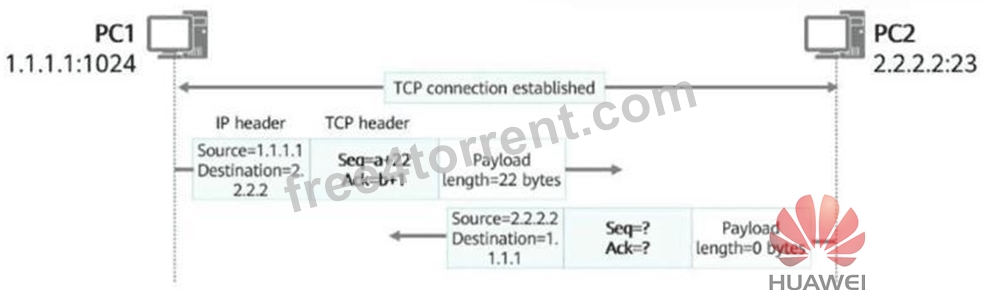
- A. a+22
- B. b+23
- C. b+1
- D. a+44
Answer: D
Explanation:
In TCP, the acknowledgment number indicates the next byte that the receiver expects to receive. In the figure, PC1 sends a TCP segment to PC2 with sequence number = a+22 and payload length = 22 bytes .
Since TCP sequence numbers count bytes, the last byte carried in this segment corresponds to sequence number a+43 . Therefore, after PC2 successfully receives this data, it sends back an ACK indicating that the next expected byte is a+44 .
That is why option B is correct. This is a standard TCP reliability mechanism. TCP does not acknowledge
"packets" as units; it acknowledges the byte stream. The ACK number always points to the next byte expected from the peer. The source and destination port numbers identify the session, but the sequence and acknowledgment numbers track ordered delivery. HCIA-Datacom uses this mechanism to explain connection- oriented transport, reliable delivery, retransmission, and traffic control. Understanding how the payload length affects sequence progression is essential when analyzing packet captures and troubleshooting TCP communication problems in enterprise networks.
NEW QUESTION # 43
......
Crack the Huawei H12-811_V2.0 Exam with Flying Colors. The Huawei H12-811_V2.0 certification is a unique way to level up your knowledge and skills. With the Understanding HCIA-Datacom V2.0 H12-811_V2.0 credential, you become eligible to get high-paying jobs in the constantly advancing tech sector. Success in the Huawei H12-811_V2.0 examination also boosts your skills to land promotions within your current organization. Are you looking for a simple and quick way to crack the Understanding H12-811_V2.0 examination? If you are, then rely on H12-811_V2.0 Dumps.
H12-811_V2.0 Reliable Braindumps: https://www.free4torrent.com/H12-811_V2.0-braindumps-torrent.html
- H12-811_V2.0 Exam Torrent - H12-811_V2.0 Test Collection - H12-811_V2.0 Top Quiz ???? Search for 【 H12-811_V2.0 】 on ( www.examcollectionpass.com ) immediately to obtain a free download ????H12-811_V2.0 Exam Vce
- Free PDF 2026 Huawei Authoritative H12-811_V2.0: HCIA-Datacom V2.0 Online Test ???? Open 「 www.pdfvce.com 」 enter ▛ H12-811_V2.0 ▟ and obtain a free download ????H12-811_V2.0 Latest Exam Format
- TOP H12-811_V2.0 Online Test: HCIA-Datacom V2.0 - High Pass-Rate Huawei H12-811_V2.0 Reliable Braindumps ???? Enter ☀ www.troytecdumps.com ️☀️ and search for ➠ H12-811_V2.0 ???? to download for free ????Dumps H12-811_V2.0 Guide
- Huawei H12-811_V2.0 Web-Based Practice Exam Questions Software ???? Open ➠ www.pdfvce.com ???? and search for ⇛ H12-811_V2.0 ⇚ to download exam materials for free ????Certification H12-811_V2.0 Book Torrent
- TOP H12-811_V2.0 Online Test: HCIA-Datacom V2.0 - High Pass-Rate Huawei H12-811_V2.0 Reliable Braindumps ???? Search for ➽ H12-811_V2.0 ???? and download it for free immediately on ⇛ www.pdfdumps.com ⇚ ????Certification H12-811_V2.0 Book Torrent
- H12-811_V2.0 Learning Engine ???? Certification H12-811_V2.0 Book Torrent ???? Reliable H12-811_V2.0 Test Camp ???? Simply search for ▶ H12-811_V2.0 ◀ for free download on ⏩ www.pdfvce.com ⏪ ????Reliable H12-811_V2.0 Test Camp
- Free PDF 2026 Huawei Authoritative H12-811_V2.0: HCIA-Datacom V2.0 Online Test ☸ Search for ➽ H12-811_V2.0 ???? and obtain a free download on ➡ www.examcollectionpass.com ️⬅️ ????Valid H12-811_V2.0 Test Blueprint
- Exam Questions for the Huawei H12-811_V2.0 Exam 2026 - Pass Easily ???? Easily obtain 「 H12-811_V2.0 」 for free download through ⮆ www.pdfvce.com ⮄ ????Valid H12-811_V2.0 Study Plan
- Updated www.prepawayete.com Huawei H12-811_V2.0 Exam Questions in Three Formats ???? Simply search for ➡ H12-811_V2.0 ️⬅️ for free download on ⮆ www.prepawayete.com ⮄ ????Exam H12-811_V2.0 Simulations
- 100% Pass-Rate H12-811_V2.0 Online Test Offers Candidates Excellent Actual Huawei HCIA-Datacom V2.0 Exam Products ???? Copy URL “ www.pdfvce.com ” open and search for ✔ H12-811_V2.0 ️✔️ to download for free ????Certification H12-811_V2.0 Book Torrent
- Certification H12-811_V2.0 Book Torrent ???? H12-811_V2.0 Reliable Test Objectives ???? Certification H12-811_V2.0 Book Torrent ???? Search for ➠ H12-811_V2.0 ???? and download it for free on “ www.examcollectionpass.com ” website ????Useful H12-811_V2.0 Dumps
- superdirectorys.com, totalbookmarking.com, edvision.tech, jonascckc073512.blogozz.com, alexiaebov958949.wikilinksnews.com, andrewdkgg138225.wiki-jp.com, kianatiyd926699.luwebs.com, laylaprnn980411.ssnblog.com, alvincibr880628.blogvivi.com, www.stes.tyc.edu.tw, Disposable vapes